
Surface Tension and Salts in Solution
Surface tension has been threshed out pretty thoroughly by articles appearing in the Journals of the American Chemical Society, beginning in 1908. These articles deal with the drop-weight method (weight of a falling drop) for the determination of molecular weight, critical temperature, and surface tension, and they describe the apparatus used. The work was started […]
Gold & Silver Recovery from Mexican Ore

The mill receives 200 tons per clay of crude mine ore. After being crushed to 2-inch size, this ore is passed over a picking-belt, where one ton of high-grade ore and four tons of waste are removed each day. The remaining 195 tons of second-class ore is crushed in stamp-batteries to pass a 4-mesh screen. […]
Flotation of Copper Ores

Pneumatic flotation is already fully established in a number of places and the results in comparison with the other and older schemes fully justify the opinion of your correspondent that it constitutes the most distinct advance in flotation in recent years. The first pneumatic-flotation plant in this country was erected by me in February 1914 […]
Process Air & Plant Air
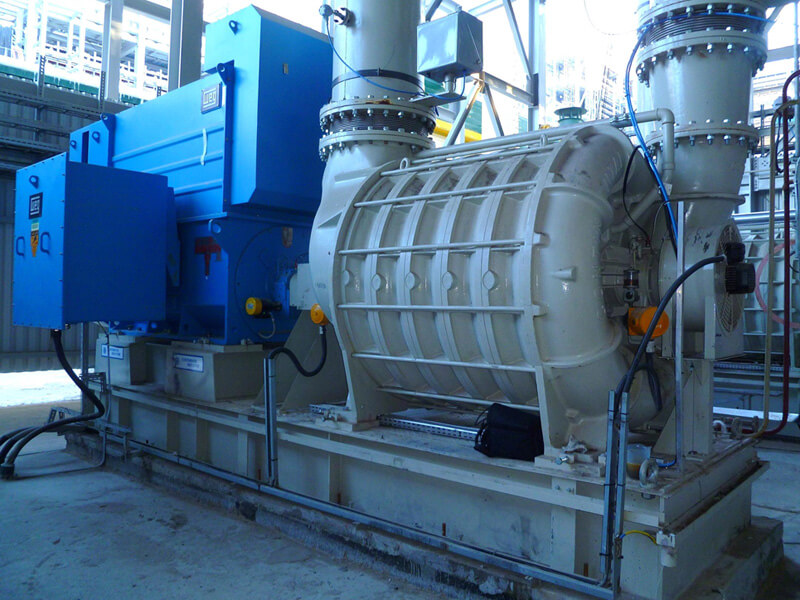
Process air is supplied to the process by two 150 HP, 1200 nm3/hr, 250 kPa compressors. Each compressor is a totally self-contained package. Each compressor is an electric motor driven, single stage screw compressor complete with accessories piped, wired and baseplate mounted. Under normal operating conditions only one of the two compressors will be used. […]
Preparing Flotation Reagents

The following flotation reagent mixing system is typical for the flotation reagent mixing systems: A-208, Xanthate and Sodium Silicate. The reagent mix tanks, for the above mentioned reagents, are located on the basement floor. Feed chutes from the main operating floor carry dry or wet reagents to each mix tank. Either reclaim or fresh water is […]
Lime Addition System
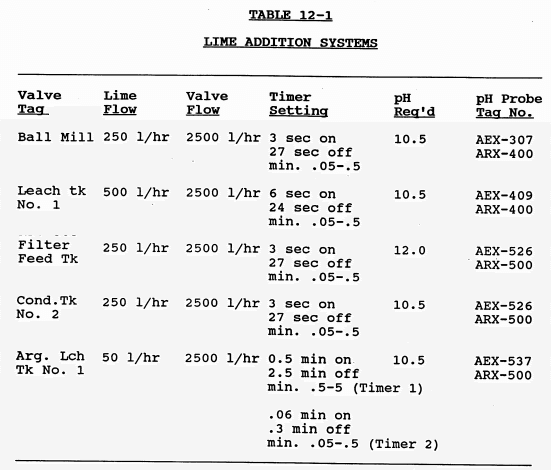
The lime system is a packaged unit which operates automatically and continuously. The equipment provided in the package includes the lime silo, rotary feeder, lime slaker and lime slurry mix tank and agitator. The lime system is equipped with its own PLC which automatically provides lime slurry for the process. Hydrated lime is stored in a […]
Silver Sulphide Leaching & Filtration Circuit Startup & Shutdown Procedures
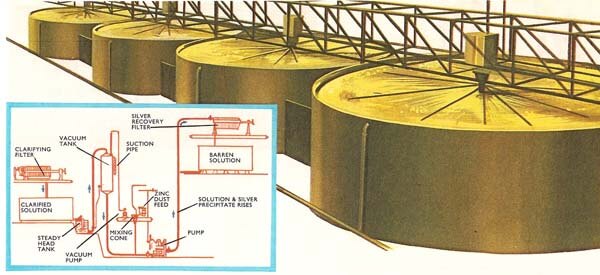
Details of good silver sulphide leaching and filtration circuit operation and instructions for sequencing and preparing for startup. The following items must be checked before the equipment in this EXAMPLE Argentite Leaching Circuit is started. The leach tank agitators should be running. Check that the Argentite filter feed pump, drum filter, repulper and tailings sampling pump […]
Silver Flotation Concentrate Leaching and Filtration Circuits
Producing a Silver Flotation concentrate from this EXAMPLE Argentite (cubic silver sulfide (Ag2S)) Flotation Circuit enters the first of four successive Argentite leach tanks. The purpose of this leach circuit is to dissolve the silver and gold recovered in the Flotation Circuit. A high strength solution of sodium cyanide, air, and lime are added to the […]
Flotation Circuit Startup and Shutdown Procedure
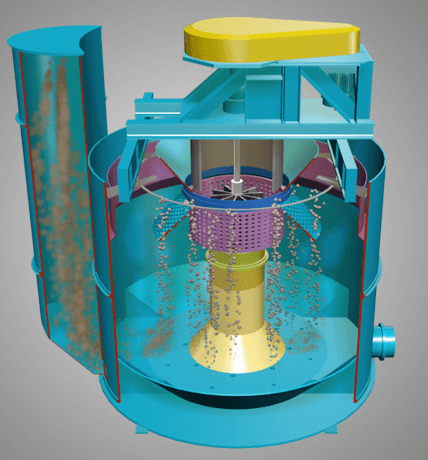
In preparation for this EXAMPLE Startup, the following items must be checked before the associated conditioning and flotation equipment and circuit is started. Ensure that all applicable reagent systems are operational, and that the conditioning tank agitators, flotation feed pumps, flotation mechanisms, flotation blower, and the rougher concentrate, cleaner tails, and argentite leach feed pumps are operational. The samplers […]
Silver Mineral Argentite Flotation Circuit
Solid residue from the second filtration stage is repulped with reclaim water to 35% solids, and is pumped to our EXAMPLE Conditioning and Argentite Flotation Circuit which is a process for the recovery of this Silver Mineral. A large portion of the silver in the ore will not have been leached in the initial grinding and […]