
Millerite Serapation from Pentlandite and Chalcopyrite
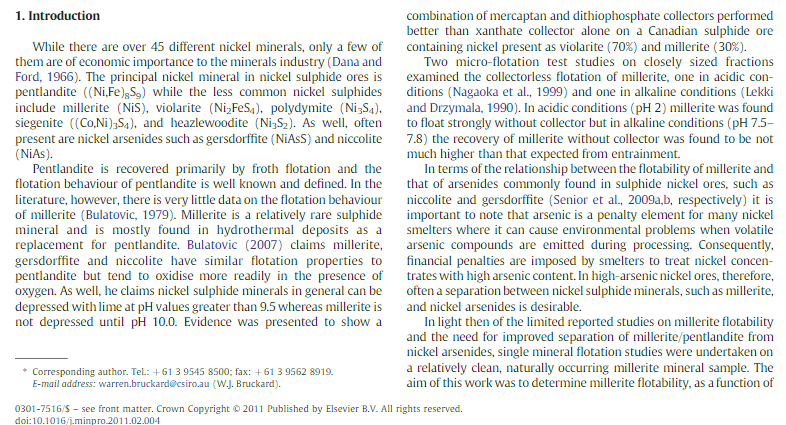
While there are over 45 different nickel minerals, only a few of them are of economic importance to the minerals industry. The principal nickel mineral in nickel sulphide ores is pentlandite ((Ni,Fe)8S9) while the less common nickel sulphides include millerite (NiS). violarite (Ni2FeS4), polydymite (Ni3S4), siegenitc {(Co,Ni)3S4), and heazlewoodite (Ni3S2). As well, often present are […]
Flotation in Mineral Processing: Recovery and Efficiency
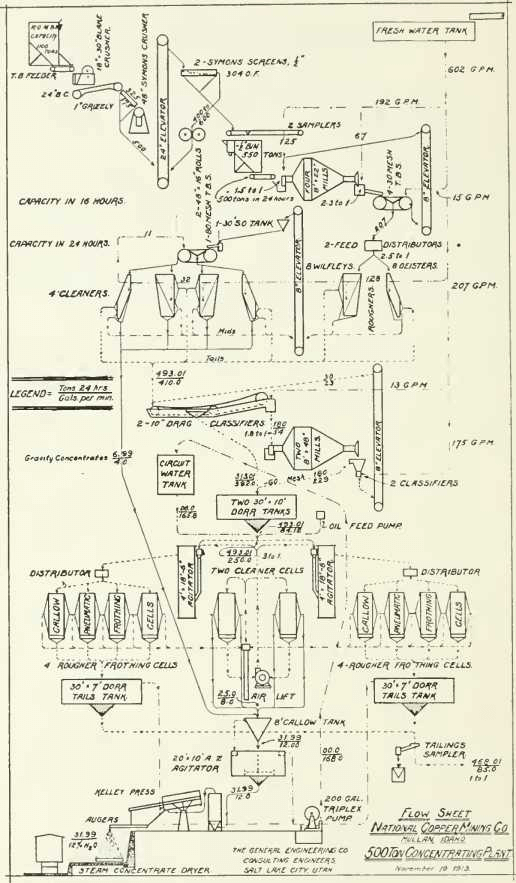
The FLOTATION PROCESS is one of the commonest methods of extracting the valuable minerals from certain classes of ores, and it is generally more efficient as regards the recovery of the minerals than any other process applicable to the treatment of similar types of ores. The metallic contents of the minerals are recovered from the […]
Why do Minerals Float

I was very much interested in reading an article by Charles T. Durell, appearing in the Mining and Scientific Press of September 18, under the caption ‘”Why do Minerals Float?’ However, I find myself unable to agree with Mr. Durell’s line of argument, and for the following reasons: In the first place I believe that […]
Flotation Oils

The work of the past two years at many mills in the United States, Mexico, and South America, has done much to prove the suitability of flotation processes to the recovery of the sulphide ores of copper, and to indicate the best reagents. In a general way, it may be said that oils of mineral […]
Processing Gold Ore by Flotation
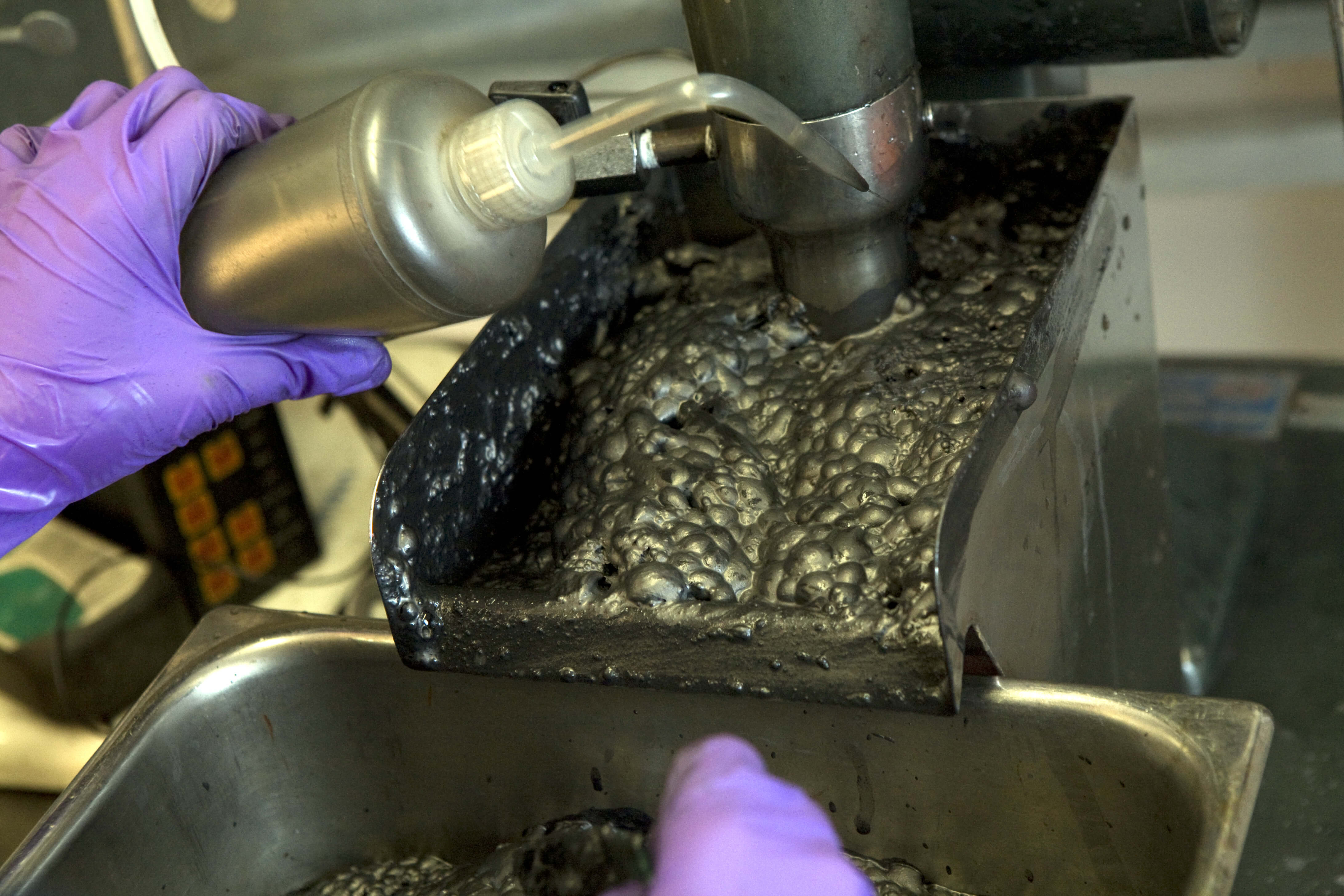
APPLICATION OF FLOTATION TO GOLD ORE A flotation plant is being erected at the Falcon mine, Rhodesia, to treat ore containing gold and copper. With the exception of the Mt. Morgan, the Etheridge, and the Great Fitzroy mines, Queensland, I have not heard of the flotation process being used successfully to treat ore containing an […]
Better Agitation for Better Recovery
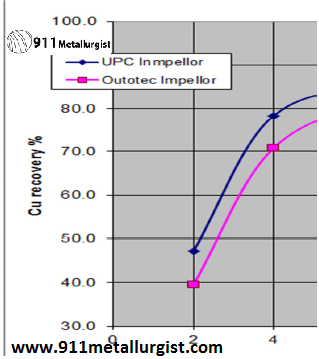
A laboratory trial to first prove the concept was followed by full scale plant trials to prove the efficacy of the design compared to a current market leader rotor/stator supplier. LABORATORY TRIAL The laboratory trial was carried out at the AMML laboratory in Gosford by Graeme Sheldon on a copper ore from Queensland. This trial was purely […]
Flotation Cyanidation CIL Tailings
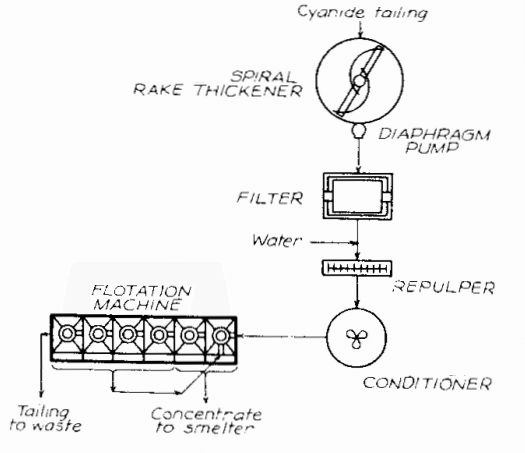
This simple process flowsheet allows for Flotation Cyanidation Tailings in cases where ore bodies at depth have become more refractory and dotation ahead of cyanidation would call for major and expensive mill alterations, the sulphide minerals containing the undissolved precious metals can be recovered by flotation and shipped to the smelter. In some cases it […]
Froth Flotation Rule of Thumb

Here is a list of Rules of Thumb often used in Froth Flotation: Clean metallic gold particles (free gold) finer than 200 microns (65 mesh) float readily with appropriate reagents. Gravity separation is desirable for larger particles. Source: Mining Chemicals Handbook (Cyanamid). When designing the flotation circuit for a proposed mill, the scale-up factor for flotation retention times […]
Chrysocolla Flotation
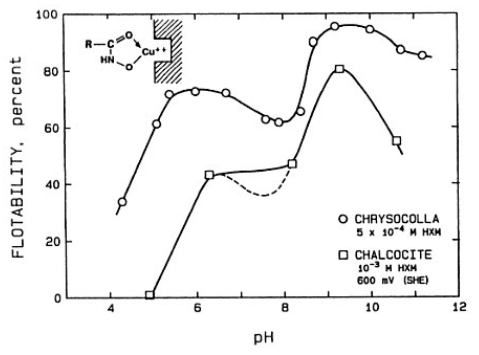
The effect of pH on the flotation response of Chrysocolla and chalcocite with potassium octyl hydroxamate as collector. The potential for the chalcocite system is slightly oxidizing. A detailed electrochemical investigation of chalcocite with a collector that does not oxidize, namely a chelating compound, potassium octyl hydroxamate shows the pH dependence of the floatability of chrysocolla (a hydrous […]
Flotation Tests
Batch and continuous flotation tests are the quickest, safest, and most economical method of determining flotation and other ore dressing problems. Best use an ore testing facilities under the direction of experienced metallurgical engineers. Tests eliminate errors and are moderate in cost. Laboratory equipment is available for complete tests covering grinding, flotation, gravity concentration, amalgamation, leaching, […]