
Jameson Flotation Cell
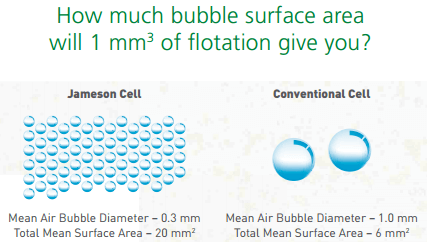
The Jameson Flotation Cell Technology is owned by GlenCore. The heart of the technology is the machine’s ability to create small uniform air bubbles. Learn more at https://jamesoncell.com/EN/Downloads/Documents/brochure_en.pdf or by watching this video of a Jameson Flotation Cell operating principles.
How Froth Flotation Works
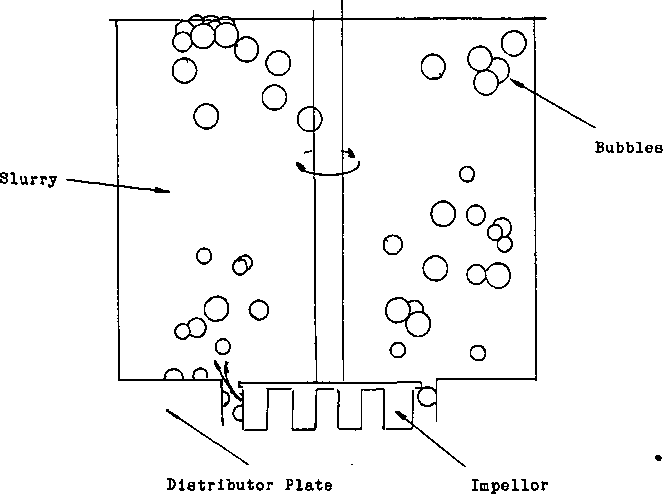
To start with I will give you a simplified description of how selective froth flotation works, lets start over again with a description of the equipment and why it works. When the grinding circuit is finished with the ore it will be ground very fine and the density of the slurry will be between 30% to 45% […]
Molybdenum Flotation
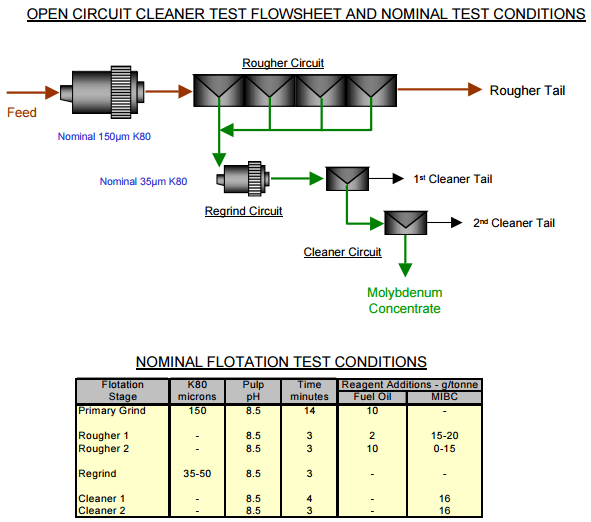
A Molybdenum Flotation case study with about 6% of the molybdenum contained in the feed is present as an oxide form and about 90% of this is not recovered to the flotation concentrate. Recovery of molybdenum into the rougher concentrate varied between 90 to 95% at a concentrate grade of 2.5 to 3.7% molybdenum. The […]
Effect Of Primary Grind Size On Mineral Liberation

The extrapolated ore fragmentation and copper sulphide liberation plots reveal that the liberation levels and hence the flotation responses of the minerals would be essentially constant across a broad range of flotation feed sizing. This observation would indicate that flotation feed sizing coarser than 200µm K80, the practical norm for copper porphyry ore processing worldwide, […]
Fluorine Dispersion
In some cases, Mica carries Fluorine. If you can not pre-float that Mica, you may want to try the Fluorine Dispersant below. Product: Oxfloat 25P – Metaphosphate As a mining chemicals for flotation treatment of multi-metallic ores Preparation: Make 2% solution in water. Dissolves readily. Dosage for good dispersion: Dosage between 100 – 1000 g/t. Product: […]
MgO Talc Depression
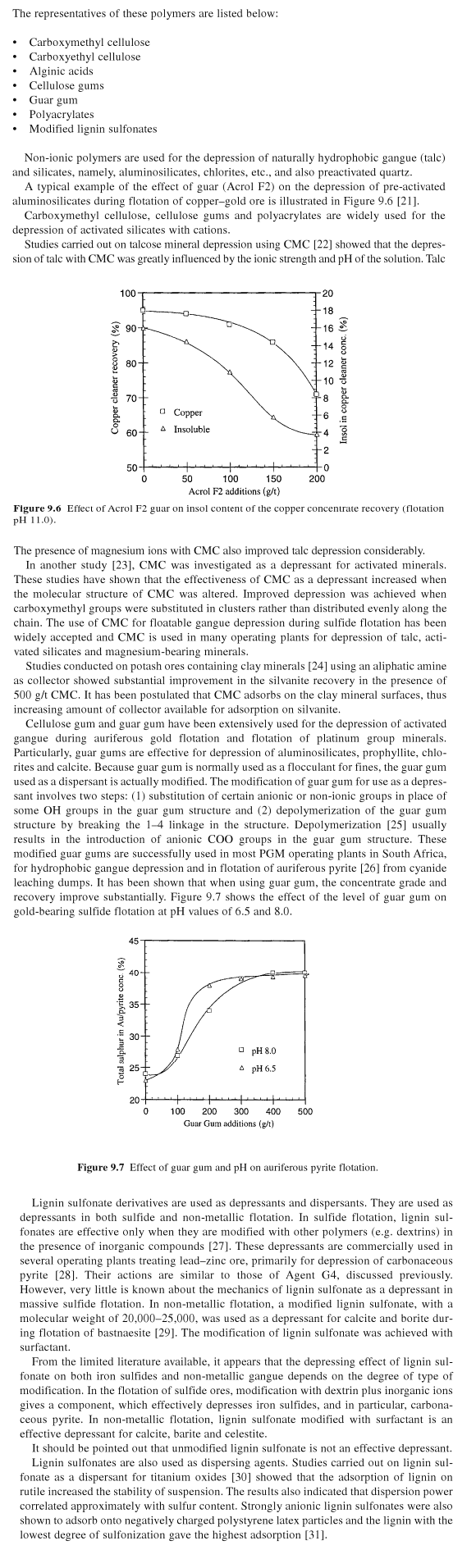
Product: Oxfloat D100 is of the CMC family of depressant. With the purpose of MgO Depression, this is commonly used in Southern Africa for Talc depression in PGM/Nickel flotation circuits. Also known as SODIUM CARBOXYMETHYL CELLULOSE Preparation: Make 0.5% solution in water. Add product to water into stirred beaker to prevent lumping. Allow sufficient time to dissolve. […]
Pruebas de ciclo cerrado y su procedimiento

Una prueba de flotación de ciclo cerrado (locked cycle test en inglés) es usualmente efectuada al final de un programa de pruebas de flotación de laboratorio, y tiene como objetivo principal confirmar las mejores condiciones de flotación obtenidas en la etapa de pruebas abiertas. Para lo cual se busca evaluar la dosificación de los reactivos […]
Conceptos Básicos de Flotación de Minerales

El proceso de flotación de minerales está basado en procesos fisicoquímicos que ayudan a explicar la afinidad de algunas partículas al aire (esta característica es llamada hidrofobicidad), y también de la afinidad de otras partículas minerales por el agua (esta característica es llamada hidrofilicidad). El objetivo del proceso es tratar de obtener un producto comercial […]
Types of Anionic Collectors of Sulphides

Collectors for sulphide minerals : Anionic collectors are most commonly used for sulphide minerals. By reference to the table (below) it will be note that they are all structurally similar, each having a single sulphur atom double bonded to either a carbon or phrosphorus atom, hence all of the sulphide minerals can be floated with […]
Cassiterite Flotation – Tin Oxide
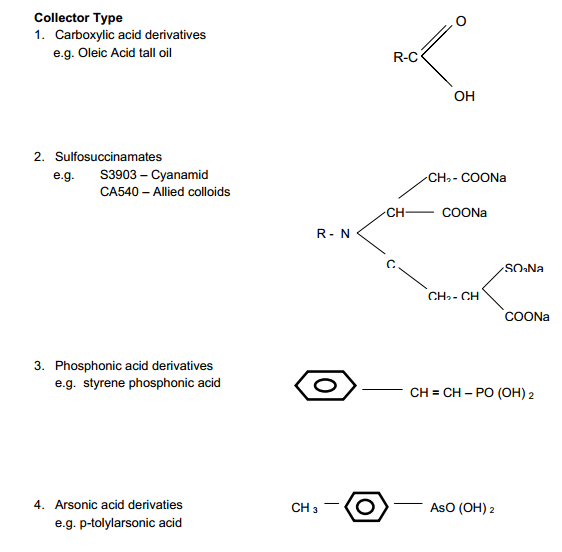
The nominal size range for cassiterite flotation is between 2 and 100 microns. The top size is variable depending upon the liberation of the cassiterite particles. Cassiterite grains coarser than 100 microns are difficult to float whilst grains finer than 2 microns give selectivity problems. Hence the feed for cassiterite flotation should be reduced to […]