
Copper – Lead Separation by Lead Depression
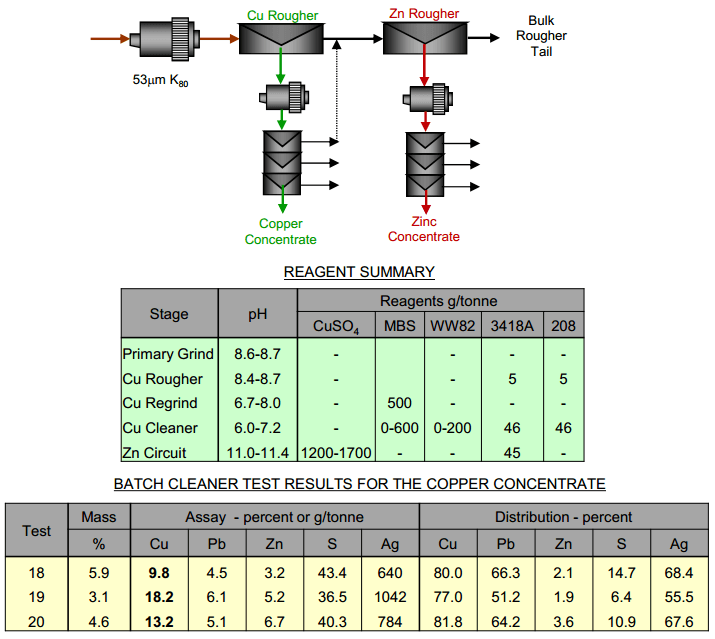
Another method to separate Pb from Cu is in depressing the lead away from the copper to float. Here, three batch cleaner tests were performed with additional depressants to reject more lead from the copper flotation concentrate. The baseline test utilized no MBS depression in the rougher circuit to maximize copper recovery, but MBS depression in the copper […]
How to Separate Copper from Lead by Cu Depression
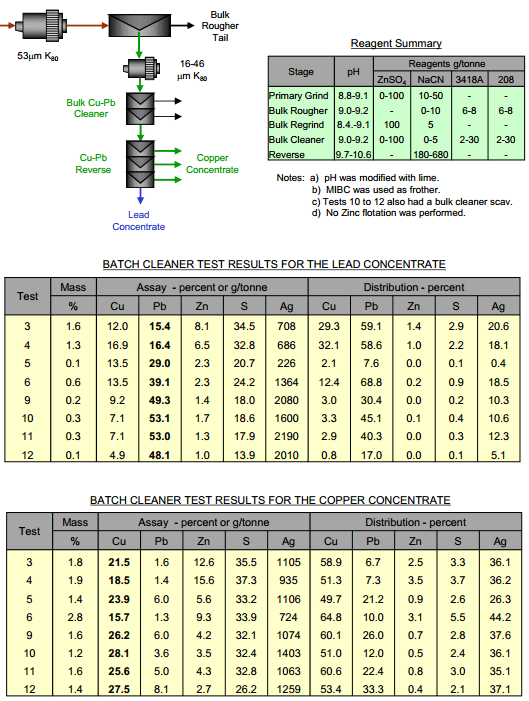
How you separate Pb from Cu depends on how much of each metal is present. You best depress the metal that’s the most present, the metal you have the most of & you float the metal you have the least of. In this case, flotation of a small amount of lead from the copper concentrate would […]
Flotation Foam

The process depends upon the fact that minerals with a metallic lustre, when treated in the form of a wetted pulp, adhere to oil, while earthy minerals do not. Two distinct operations are involved; first, the separation of the metallic mineral from the gangue by means of oil; second, the extraction of the mineral from […]
Measure and Evaluate Flotation Tail Losses
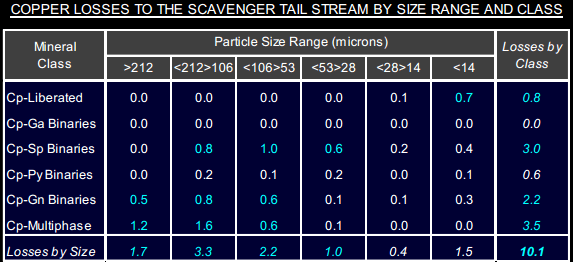
In this example, the losses of chalcopyrite to the copper scavenger tail is equivalent to about 10 percent of the copper in the ore. Losses of liberated chalcopyrite are minimal accounting for less than 1% of the copper in the feed. Most of these losses occurred as grains sized smaller than 14µm in equivalent diameter. About 55% of the […]
Silver & Gold Cyanide Leaching of Copper Ore

Much work has been done on the effect of copper in cyanide solutions on the leaching of gold. It is generally accepted that copper in cyanide solutions can form complex ions such as Cu(CN)2-, Cu(CN)3=, and Cu(CN)4=-, although Cu(CN)3= is considered the most probable of these. According to leach scientists, the complex having an empirical formula […]
Effect of Regrinding
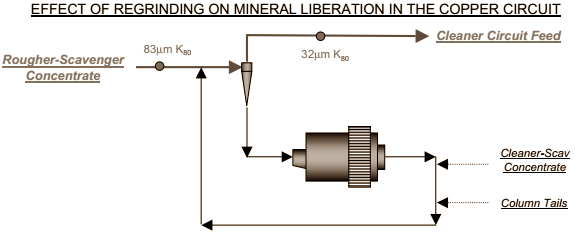
To ensure adequate mineral liberation is achieved ahead of the dilution cleaner circuit, a regrind mill is installed on the combined copper rougher-scavenger concentrate stream. See below the mineralogically limiting grade recovery chart, summarizing the theoretical limits to metallurgy imposed by the mineralogical associations in the cleaner circuit streams: Regrinding of the copper rougher-scavenger […]
Gold & Copper Bioleaching
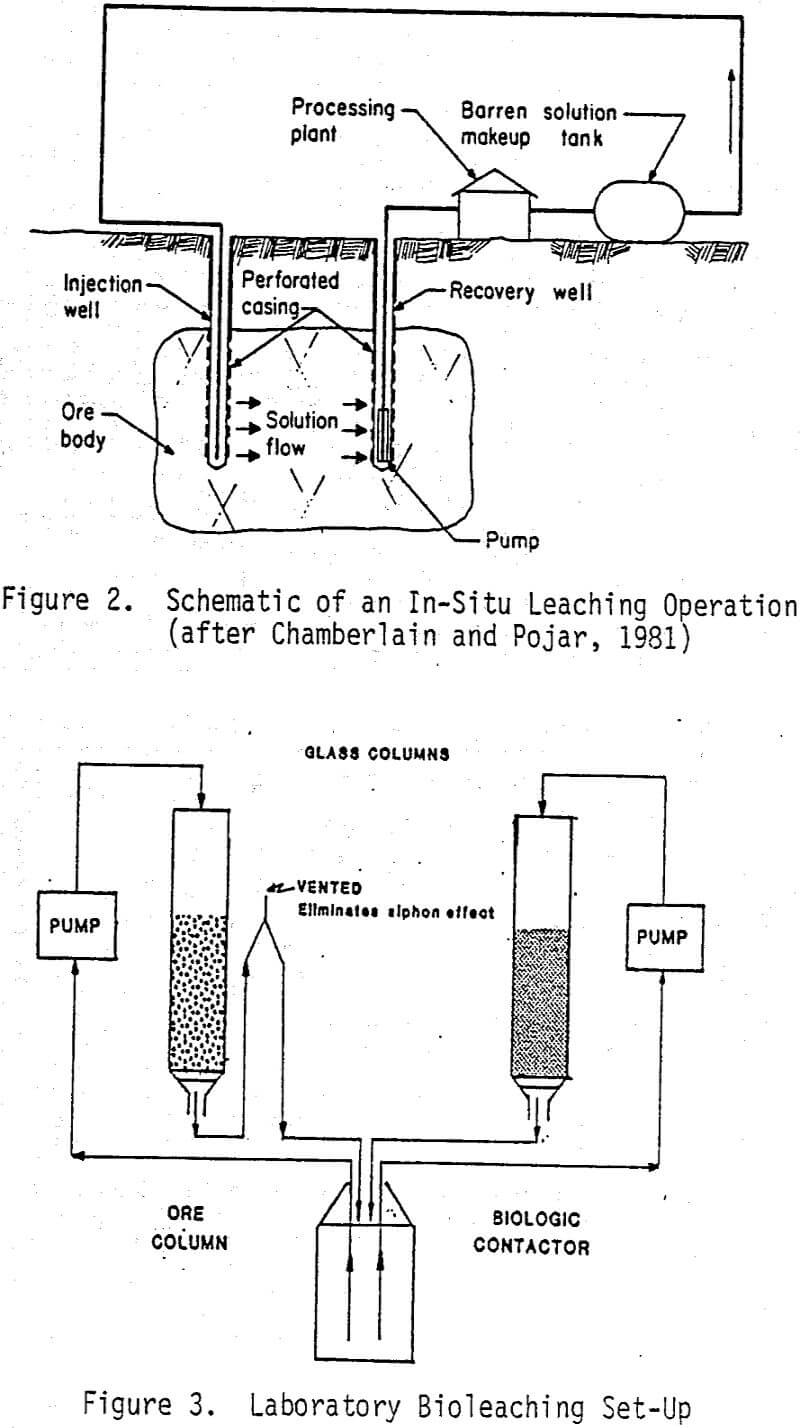
Bacterial Leaching of Copper Ores Several types of bacteria capable of living in an acid environment have been isolated from copper mine waters. The foremost of these are of the genus Thiobacillus (T.). Thiobacillus bacteria are acidophilic aerobic chemolithotrophs which grow most rapidly at a pH in the range of 2-3. T. ferrooxidans derive their […]
Effect of pH Alkalinity on Gold Leaching

The role pH has in affecting gold leaching rates by cyanide and the functions of calcium hydroxide in cyanidation are as follow: 1. For safety and to prevent loss of cyanide by hydrolysis. 2. To prevent loss of cyanide by the action of carbon dioxide in the air. 3. To decompose bicarbonates in mill water […]
Fluorine Penalties of Copper Concentrate
F Penalties often start at 300 – 500 ppm which is to say 300 ppm in Japan / Korea and perhaps ~ 500 ppm into China. Penalty scales of US $1- 2/dmt per 100 ppm. Some cases Fluorine (F): US $1.00 per dmt for each 100 ppm over 300 ppm Others F: US $2.00 per […]
Flotation: From Alchemy & Art to Physics and Science
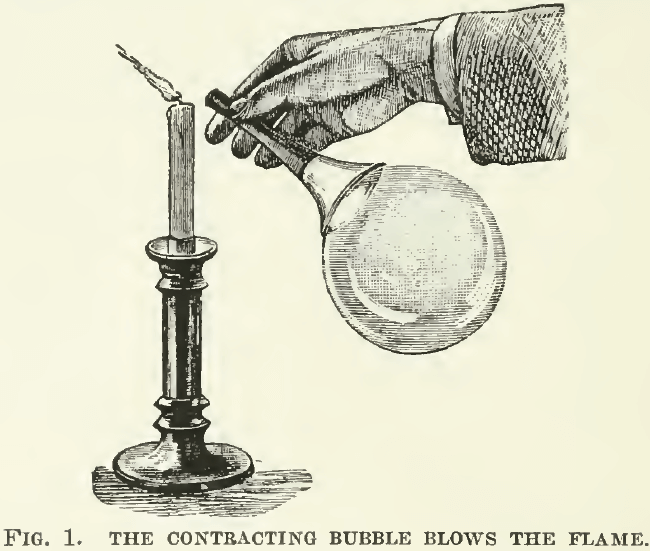
In a recent reminiscence my friend Ben Stanley Revett has recorded how he bet “a bottle of bubbles” with that peripatetic philosopher Thomas F. Criley, the partner of Carrie Jane Everson in an oil process of concentration whereby the valuable sulphides were made to float above the worthless gangue in a pulp of crushed ore. […]